
Contents
Overview
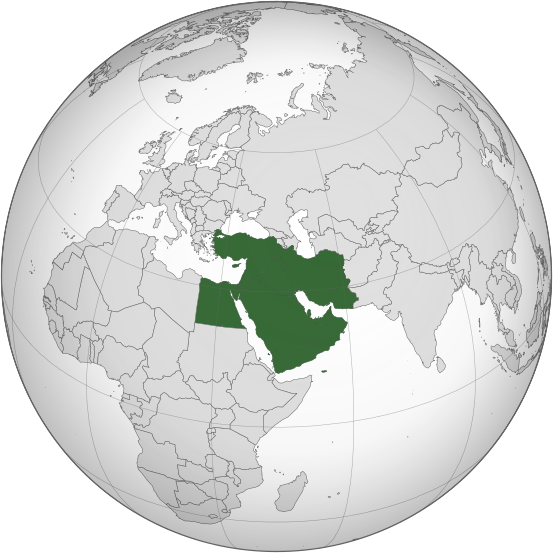
The Middle East is a vast and complex geopolitical region, primarily defined by its location at the crossroads of Africa, Asia, and Europe. It encompasses Egypt and most of Western Asia, including countries like Iran, Turkey, Iraq, Saudi Arabia, and the Levant. This region has been a nexus of trade, empires, and intellectual exchange for millennia. Its strategic importance, driven by abundant oil reserves and critical waterways like the Suez Canal and the Strait of Hormuz, has made it a focal point of global politics and conflict throughout the 20th and 21st centuries. The diverse cultures, ancient histories, and ongoing geopolitical dynamics of the Middle East continue to shape global affairs.
🎵 Origins & History
Historically, this region was known to Europeans as the "Near East," a term that gradually fell out of favor. Its ancient roots, however, stretch back to the dawn of civilization. Empires left indelible marks on the region's cultural and political landscape, fostering innovations in mathematics, astronomy, medicine, and philosophy that profoundly influenced global development. The discovery of oil in the early 20th century, particularly in Saudi Arabia and Iran, fundamentally reshaped its global significance and attracted intense international interest, setting the stage for modern geopolitical dynamics.
⚙️ Defining the Region
Defining the precise boundaries of the Middle East is a perpetual challenge, often influenced by political, cultural, and economic considerations rather than strict geographical lines. While generally encompassing Egypt and Western Asia, its exact composition varies. Some definitions include parts of North Africa, while others extend to include Afghanistan or Cyprus. This ambiguity is partly due to its historical role as a bridge between continents and cultures, making it a fluid concept. The presence of major oil reserves and critical shipping lanes like the Suez Canal and the Strait of Hormuz further cement its global importance, often leading external powers to shape its definition based on their strategic interests.
📊 Key Facts & Numbers
The region also contains significant natural gas reserves, particularly in Qatar and Iran. Despite its wealth in hydrocarbons, economic disparities are vast, with some nations boasting extremely high GDP per capita due to oil revenues, while others face significant economic challenges. The population growth rate in many Middle Eastern countries remains above the global average, posing demographic and resource management challenges.
👥 Key People & Organizations
Figures like Cyrus the Great of Persia, Saladin, and Suleiman the Magnificent of the Ottoman Empire left lasting legacies. In the 20th century, leaders such as Gamal Abdel Nasser of Egypt, Ayatollah Ruhollah Khomeini of Iran, and Yasser Arafat of the Palestine Liberation Organization (PLO) were central to regional politics. Key international organizations like OPEC (Organization of the Petroleum Exporting Countries) and regional bodies such as the Arab League play significant roles in coordinating policies and addressing common concerns, though their effectiveness is often debated.
🌍 Cultural Impact & Influence
Its contributions to art, architecture, literature, and music are vast, from the intricate geometric patterns in Islamic art to the epic poetry of Rumi and the foundational texts of Western philosophy and science preserved and expanded upon during the Islamic Golden Age. Modern Middle Eastern cinema, such as the works of Nadine Labaki, has gained international acclaim, offering nuanced perspectives on regional life. Culinary traditions, from Persian kebabs to Levantine mezze, are celebrated worldwide, demonstrating a pervasive and enduring cultural influence that transcends political boundaries.
⚡ Current State & Latest Developments
The aftermath of the Syrian Civil War continues to destabilize neighboring countries, while the Israeli-Palestinian conflict remains a central point of contention, with recent escalations highlighting its enduring complexity. Regional rivalries, particularly between Iran and Saudi Arabia, continue to play out through proxy conflicts in Yemen and elsewhere. Efforts towards normalization between Israel and several Arab states, facilitated by the Abraham Accords, represent a significant shift, though their long-term impact is still unfolding. Economic diversification away from oil is a growing priority for many Gulf states, with initiatives like Saudi Vision 2030 aiming to transform their economies. The region is also grappling with the impacts of climate change, including water scarcity and rising temperatures.
🤔 Controversies & Debates
The definition and scope of the Middle East itself are subjects of ongoing debate, particularly concerning the inclusion of countries like Turkey and Iran, which straddle cultural and geographical divides. The role of external powers, from the United States' historical involvement to Russia's resurgence in Syria, is another point of contention. Furthermore, the vast wealth generated by oil resources has led to debates about equitable distribution, governance, and the potential for "resource curse" phenomena, where abundant natural resources hinder broader economic development and fuel corruption.
🔮 Future Outlook & Predictions
The future of the Middle East is likely to be shaped by several key trends. Continued efforts towards economic diversification, particularly in the Gulf states, may reduce reliance on oil revenues and foster new industries, potentially altering regional power dynamics. The ongoing demographic shifts, with large youth populations in many countries, could lead to either increased innovation and economic growth or social unrest if opportunities are not created. The resolution of long-standing conflicts, such as the Israeli-Palestinian issue and the various civil wars, remains uncertain but would fundamentally reshape the region's stability. The increasing impacts of climate change, especially water scarcity, will necessitate greater regional cooperation and potentially drive new technological solutions. The evolving relationship between regional powers like Iran, Saudi Arabia, and Turkey, alongside the influence of global actors, will continue to define the geopolitical landscape.
💡 Practical Applications
The Middle East's primary practical application on a global scale lies in its immense energy resources. The oil and natural gas extracted from countries like Saudi Arabia, Iran, Qatar, and the United Arab Emirates fuel economies worldwide, making the region indispensable to global energy security. Beyond energy, the Middle East is a critical hub for international trade and transit, with the Suez Canal in Egypt being one of the world's busiest shipping lanes, connecting the Mediterranean Sea to the Red Sea and facilitating commerce between Europe and Asia. The region also serves as a major destination for tourism, attracting visitors to its histo
Key Facts
- Category
- culture
- Type
- topic